

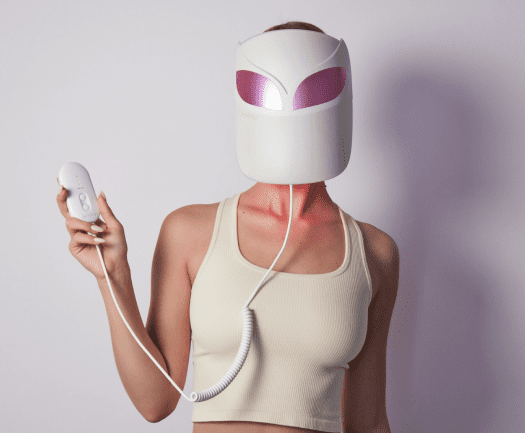

If you’re looking to revitalize your skin and wellness with red light therapy, a form of LED therapy, then keeping a consistent treatment schedule is key.
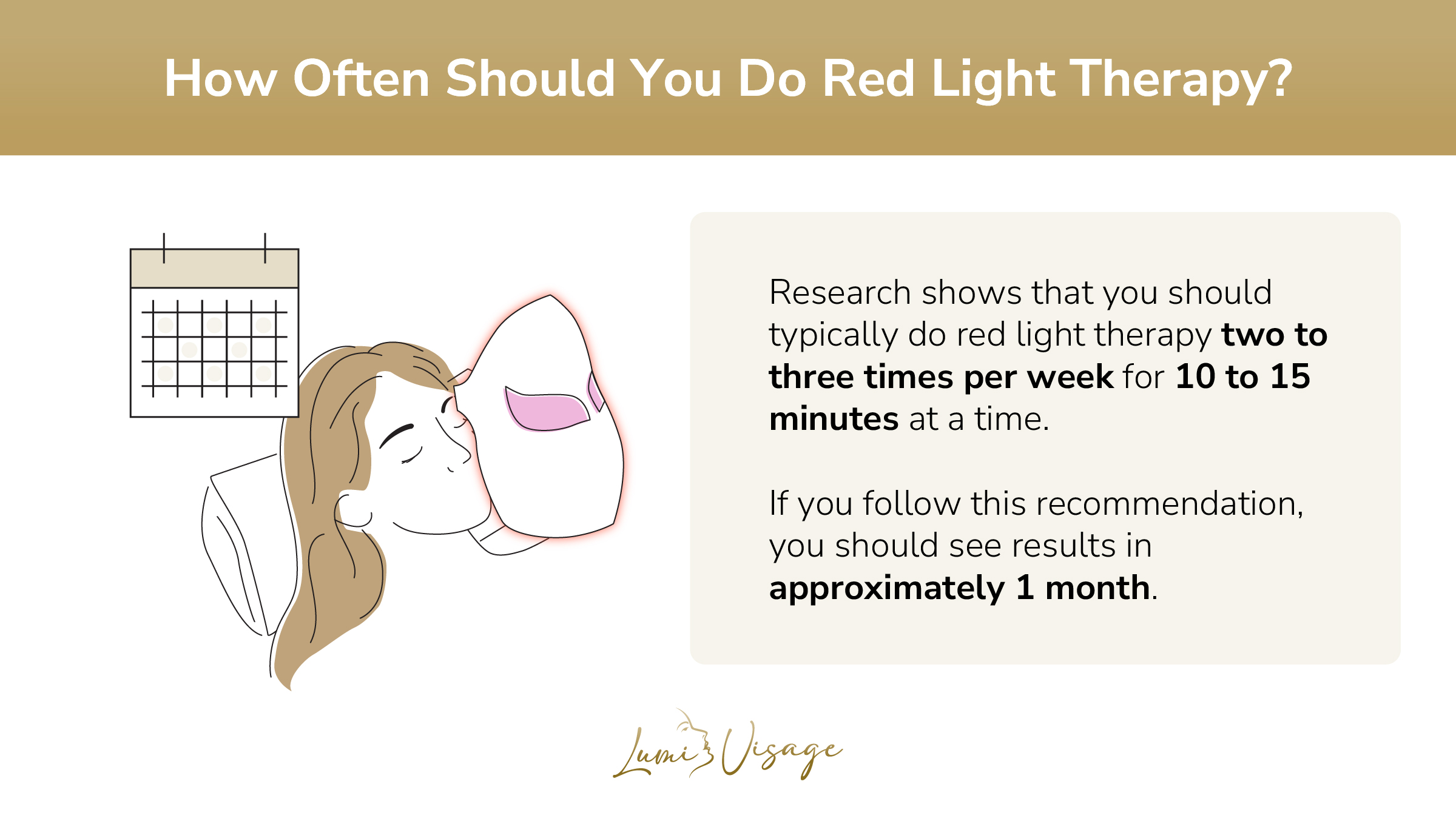
To see results, you should do red light therapy two to three times a week, with each session lasting about 10 to 15 minutes. You should give your skin a break of at least two days between each therapy session, but following this routine of frequent sessions should give you results after one month.
Your LED therapy treatment plan should be personalized to your individual needs. The regularity of treatment should depend on your device, the condition you’re treating, and your skin’s sensitivity. You should always follow the instructions that come with the device.
In this post, we explain how often you should do red light therapy for different skin issues and other ways you can get the most from your LED treatments.
Table of Contents
- Can You Do Red Light Therapy Every Day?
- How Often (and How Long) You Should Do Red Light Therapy for Different Conditions
- How Long Does It Take to See the Benefits of Red Light Therapy?
- Can You Do Red Light Therapy Too Often?
- 4 Tips for Maximizing the Benefits of Red Light Therapy
- Try Red Light Therapy at Home with Lumivisage
Can You Do Red Light Therapy Every Day?
The best usage of red light therapy is for 10 to 15 minutes at a time, up to two to three times a week. Red light therapy doesn’t involve ultraviolet light, which can harm your skin. However, excessive usage could harm your skin, causing skin irritation and redness.
LED light therapy also takes time to work. The LED light is absorbed by proteins in your mitochondria when you use your device. This leads to a cellular response that can improve your skin’s function and repair, by increasing ATP (adenosine triphosphate) and RNA synthesis, as well as increasing oxygen consumption. These mechanisms take a few days to activate, so you need a few days to maximize the benefits for your skin.
When you use your therapy is just as important as how often you use it. Don’t use at-home LED therapy after shaving, an in-office treatment, or if your skin is irritated or damaged. If you have sensitive skin, it might be a good idea to set up a treatment plan based on the individual needs of your skin.
How Often (and How Long) You Should Do Red Light Therapy for Different Conditions
Here is how often and how long you should do red LED light therapy treatments, based on different skin and health conditions.
For Anti-Aging
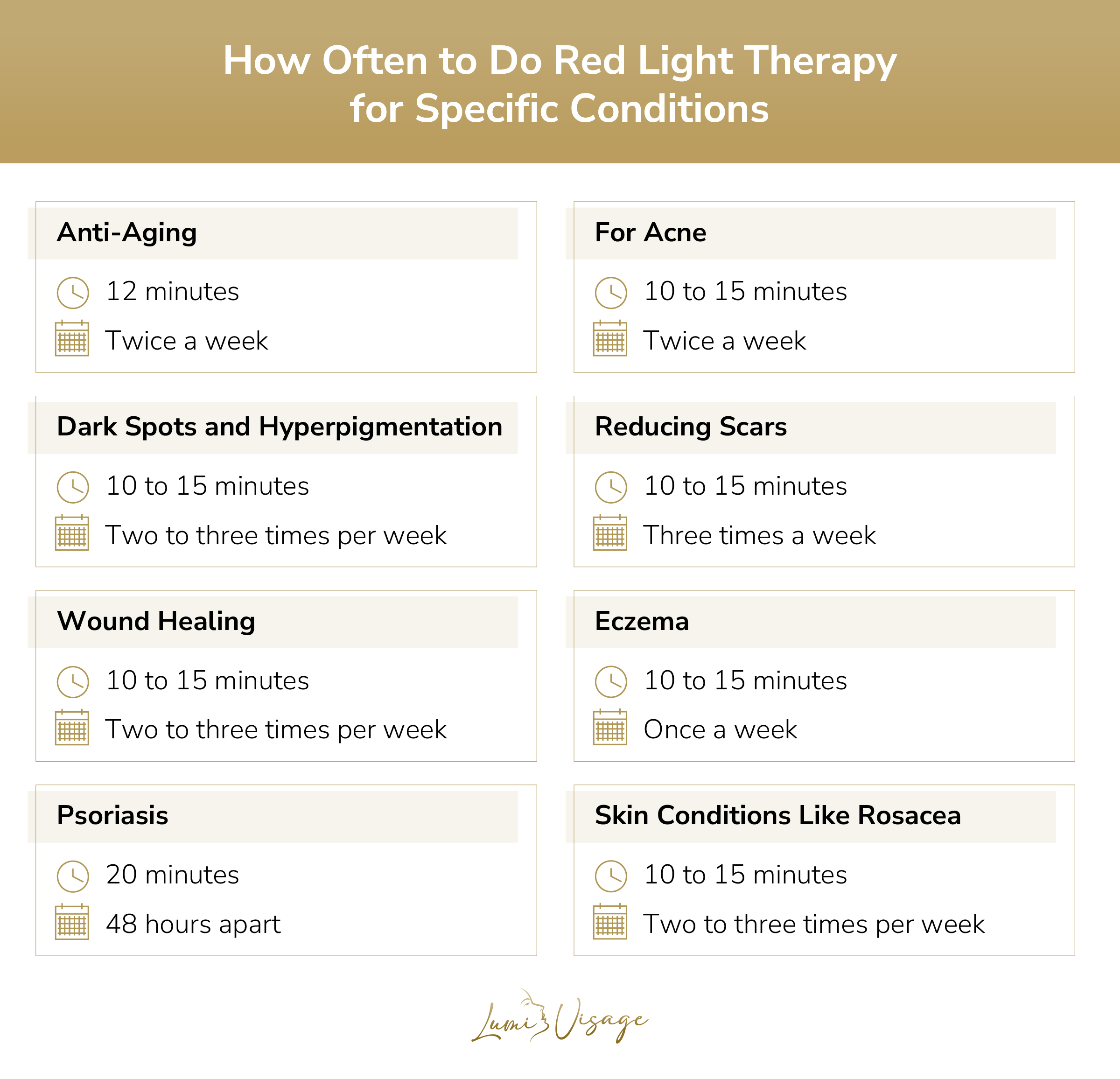
Research shows that red light has good results for anti-aging when it is used in 12-minute sessions, twice a week for three months.
Red light can treat aging by improving the production of collagen, elastin, and hyaluronic acid. These elements can make your skin firmer and smoother and decrease wrinkles and fine lines. To see these effects, you will need to be consistent with your red light device and treatment sessions.
For Acne
If you struggle with acne and want help via LED light therapy, you should use blue light twice a week for 10 to 15 minutes at a time.
You can also use red and blue light therapy to treat your acne. Red light can reduce oil production, which helps limit the emergence of pimples. Blue light reduces the appearance of acne and helps kill acne-causing bacteria on your skin. It can also normalize hyperkeratinization, limiting excess skin cells in the hair follicle and reducing the incidence of acne.
If you use your device twice a week, you should notice improvements between 2 and 12 weeks later.
For Dark Spots and Hyperpigmentation
Red light can diminish dark spots and hyperpigmentation on your skin by increasing the production of cells that produce melanin. It can also limit the production of tyrosinase, which causes less melanin to accumulate in your cells, thus evening out your skin tone.
In a study evaluating the effect of LED on reducing pigmentation in melasma patients, affected sites were treated weekly with red light therapy and were evaluated at 12 weeks. Patients showed a reduction of pigmentation as a result of the therapy treatments.
Use red light therapy two to three times per week, with each session between 10 and 15 minutes. You’ll likely start to see results after one month.
For Reducing Scars
If scars are making you self-conscious, use red light three times a week for 10 to 15 minutes at a time.
Red light therapy works to treat surgical scars, keloid scars, and hypertrophic scars. The LED red light therapy should be done three times a week, and you should be able to see results in three weeks.
For Wound Healing
Use red light therapy for wound healing two to three times per week, with each session between 10 and 15 minutes. You should see results after one month.
Red light reduces inflammation and increases organized collagen production, which will help your skin recover from the damage. NASA completed research that shows that red light speeds up the healing process and increases cell regrowth, improving your skin health.
For Eczema
Use red light therapy once a week, with each session lasting between 10 and 15 minutes. You should see results after one month. Studies also show that red light therapy can reduce the size of lesions, get rid of itchiness, and treat the symptoms of eczema overall.
For Psoriasis
Symptoms of psoriasis, such as scaly skin, can be treated with two 20-minute sessions, maintaining at least 48 hours between each use. You should follow this cycle of treatment for four or five weeks, and you can use red light and infrared light together, which would also produce optimal results.
For Skin Conditions Like Rosacea
Use red light therapy two to three times per week, with each session between 10 and 15 minutes. You should see results after one month. Both red and near-infrared light can achieve the results you wish, as these lights reduce the inflammation and new blood vessel formation that causes rosacea.
How Long Does It Take to See the Benefits of Red Light Therapy?
You can usually see the benefits of using red light therapy treatment in about a month or so, with full results and overall health appearing after three months of regular use.
Here’s how long it typically takes to see results for each condition:
- Anti-aging: 3 months
- Acne: 2 to 12 weeks
- Dark spots and hyperpigmentation: 1 month
- Scars: 3 weeks
- Wound healing: 1 month
- Eczema: 1 month
- Psoriasis: 4 to 5 weeks
- Rosacea: 1 month
To get the best results, use your LED light therapy mask consistently as part of your regular skincare routine.
Can You Do Red Light Therapy Too Often?
Red light, unlike infrared light, is not dangerous so there is no rule about using it too much. It is safe to use your device every day, but it’s not necessary and could ruin the positive effects you gain through the therapy. If you experience any skin irritation, especially through daily use, you should stop treatment and contact your healthcare professional.
Are There Any Risks to Red Light Therapy?
The effectiveness of red light therapy has been widely researched and proven safe to use. Some people have experienced redness and swelling, but those side effects go away within 24 hours.
If you feel like you need to use red light therapy, go ahead and give it a try. However, you should not use red light therapy if:
- You have a history of certain medical conditions that cause photosensitivity.
- You’re taking certain medications like Accutane or antibiotics that make you photosensitive.
Under these circumstances, the light could damage your skin and cause more harm than good.
Make sure you follow the instructions and use a device that’s FDA-cleared. For FDA clearance, the FDA ensures that the device is safe and conducts multiple tests on the product. The Lumivisage LED Face Mask is FDA-cleared and safe to use at home.
4 Tips for Maximizing the Benefits of Red Light Therapy
Here’s how you can use your mask to reap all the health benefits possible for your skin.
1. Cleanse Your Skin Before Using Your Device
Your skin absorbs light during treatment, so make sure you clean your skin or any makeup, oil, or dirt. Use a gentle facial cleanser before you use your mask, and make sure your face is dry before treatment.
2. Use a Moisturizer After Your Session
Your skin could be dry after your session, so use a gentle moisturizer to keep your skin hydrated. Using products with hyaluronic acid or green tea can help boost the benefits your skin gains during treatment.
3. Keep Your Device Clean
If your treatment plan includes a red light therapy device, residue can easily build up. Keeping your device clean will make sure the light has a clear pathway to penetrate your skin and will also prevent breakouts from happening. You can simply use a damp cloth and soap to wipe your device, then dry it and store it in a cool, dry place.
4. Stay Consistent
Consistency is the best way to ensure good, long-lasting results. Using an at-home device like the Lumivisage Face Mask allows you to have more red light therapy sessions than you would visiting a dermatologist. You can also make an LED light therapy mask a consistent part of your skincare routine.
Try Red Light Therapy at Home with Lumivisage
The Lumivisage Face Mask is the tool you need if you’re ready to start LED light therapy. With a range of different colors, this face mask can help you get the healthy-looking skin you’re looking for. It’s also FDA-cleared, meaning it’s safe for you to use at home and incorporate into your skincare routine.
Try Lumivisage at your own home today, and enjoy some skin rejuvenation!
References
Journal of Cosmetic Dermatology. “Safety, efficacy, and usage compliance of home-use device utilizing RF and light energies for treating periorbital wrinkles.” https://pubmed.ncbi.nlm.nih.gov/27910259/. Date accessed: January 23, 2024.
Skin Research and Technology. “Reverse skin aging signs by red light photobiomodulation.” https://www.ncbi.nlm.nih.gov/pmc/articles/PMC10311288/. Date accessed: January 23, 2024.
Journal of American Academy of Dermatology. “Low-level red and infrared light increases expression of collagen, elastin, and hyaluronic acid in skin.” https://www.jaad.org/article/S0190-9622%2819%2933160-3/fulltext. Date accessed: January 23, 2024.
Archives of Dermatological Research. “Regulation of lipid production by light-emitting diodes in human sebocytes.” https://pubmed.ncbi.nlm.nih.gov/25690162/. Date accessed: January 23, 2024.
Journal of Cosmetic and Laser Therapy. “Light-emitting diode 415 nm in the treatment of inflammatory acne: an open-label, multicentric, pilot investigation.” https://pubmed.ncbi.nlm.nih.gov/16581683/. Date accessed: January 23, 2024.
Lasers in Surgery and Medicine. “Low-level red LED light inhibits hyperkeratinization and inflammation induced by unsaturated fatty acid in an in vitro model mimicking acne.” https://pubmed.ncbi.nlm.nih.gov/29095531/. Date accessed: January 23, 2024.
Journal of Cosmetic and Laser Therapy. “Combination blue (415 nm) and red (633 nm) LED phototherapy in the treatment of mild to severe acne vulgaris.” https://pubmed.ncbi.nlm.nih.gov/16766484/. Date accessed: January 23, 2024.
Photodermatology, Photoimmunology & Photomedicine. “Inhibitory effect of 660-nm LED on melanin synthesis in in vitro and in vivo.” https://pubmed.ncbi.nlm.nih.gov/27696509/. Date accessed: January 23, 2024.
The Journal of Clinical and Aesthetic Dermatology. “Dual Effect of Photobiomodulation on Melasma.” https://www.ncbi.nlm.nih.gov/pmc/articles/PMC5891084/. Date accessed: January 23, 2024.
Journal of Biophotonics. “Light emitting diode-red light for reduction of post-surgical scarring: Results from a dose-ranging, split-face, randomized controlled trial.” https://pubmed.ncbi.nlm.nih.gov/33788987/. Date accessed: January 23, 2024.
Anais Brasileiros de Dermatologia. “Effects of low-power light therapy on wound healing: LASER x LED.” https://www.ncbi.nlm.nih.gov/pmc/articles/PMC4148276/. Date accessed: January 23, 2024.
NASA. “NASA Research Illuminates Medical Uses of Light.” https://spinoff.nasa.gov/NASA-Research-Illuminates-Medical-Uses-of-Light. Date accessed: January 23, 2024.
Seminars in Cutaneous Medicine and Surgery. “Low-level laser (light) therapy (LLLT) in skin: stimulating, healing, restoring.” https://pubmed.ncbi.nlm.nih.gov/24049929/. Date accessed: January 23, 2024.
Annals of Translational Medicine. “The effects of photobiomodulation therapy on inflammatory mediators, immune infiltration, and angiogenesis in a mouse model of rosacea.” https://www.ncbi.nlm.nih.gov/pmc/articles/PMC9403938/. Date accessed: January 23, 2024.