

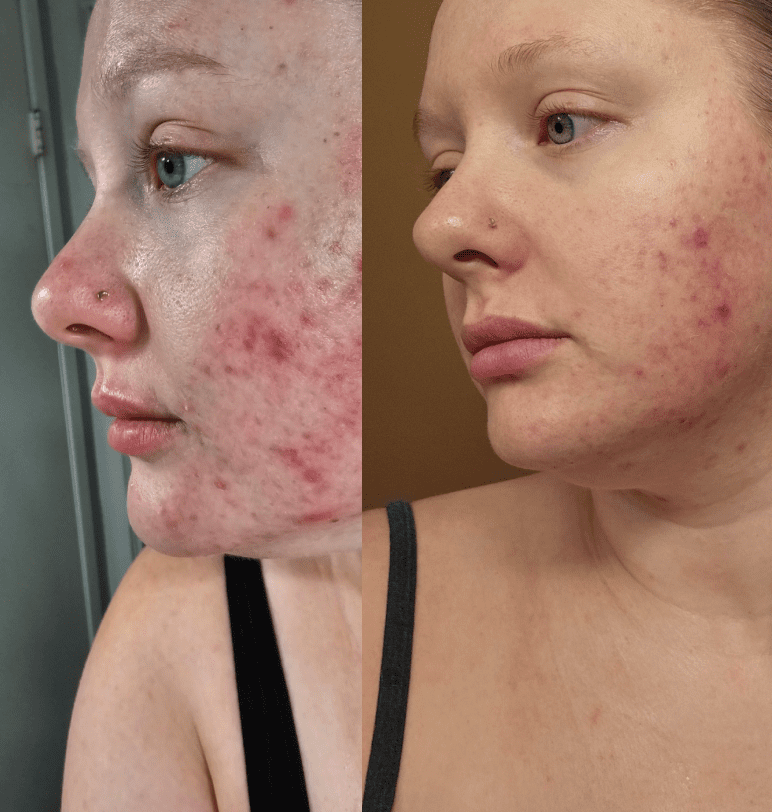

If you’ve been suffering from more than your fair share of pimples and breakouts, red and blue light therapy can help. This non-invasive treatment can treat mild to moderate acne (acne vulgaris) as well as acne scars.
Red light and blue light therapy are two forms of LED (light-emitting diode) light therapy — also low-level laser therapy or photobiomodulation. This therapy uses different wavelengths of visible light to treat a variety of skin conditions. Your dermatologist can administer it in their office, or you can safely do it yourself at home with an LED light mask.
Incorporating LED light therapy into your treatment regimen gives you another helpful tool to fight existing breakouts and prevent new ones from happening. In this post, we go over how using red and blue light therapy can help you get the clear skin you want.
Table of Contents
- What Causes Acne and Acne Scars?
- How Red and Blue Light Therapy Help Treat Acne and Acne Scars
- Can Other LED Light Therapy Colors Help?
- How Long Does Light Therapy Take to Work?
- At-Home vs. In-Office LED Light Therapy Treatment for Acne
- Using Light Therapy with Other Acne Treatments
- Light Therapy Safety Tips
What Causes Acne and Acne Scars?
Inflammatory acne (acne vulgaris) is the most common type of acne. It causes red, swollen bumps filled with dead skin cells and oil — what most people call, pimples. It can be mild or severe, and severe cases are called cystic acne.
Inflammatory acne happens when your pores clog, usually because of excess oil from your sebaceous glands, a buildup of dead skin cells, bacterial growth in the pore, or a combination of these factors. Even when you think you’re done with a breakout, acne can leave scars as it heals, especially if you pick at or squeeze the blemishes.

Acne basically results from a disruption to how your skin normally functions. Here are some of the major parts of your skin’s anatomy and how they play a role breakouts:
- Sebaceous glands: Every pore on your skin opens to a canal called a hair follicle, and each one contains a fine hair and one sebaceous gland. Sebaceous glands are important to skin health, helping produce the sebum that removes old skin cells, keeps skin moisturized, and offers antibacterial properties. But overactive oil glands can lead to excess sebum production, causing you to break out.
- Keratinocytes: Each of your follicles is lined with keratinocytes, a type of skin cell. As your body naturally sheds dead skin cells, they rise to the surface of your skin. But sometimes, these dead skin cells get stuck together with hair and sebum inside the pore, preventing the cells and sebum from getting out and causing hyperkeratinization.
- Bacteria: Bacteria normally live on the surface of your skin. But when your pores are clogged with oil and skin cells, bacteria can grow inside of them and cause inflammation. Then, when the walls of the clogged follicle break down, the bacteria, along with skin cells and sebum, spills onto the skin around it, causing breakouts.
- Inflammatory mediators: Acne triggers an immune response, which means your immune system tries to help by sending out inflammatory mediators. Unfortunately, these usually increase inflammation and redness, making your breakout look even worse.
How Red and Blue Light Therapy Help Treat Acne and Acne Scars
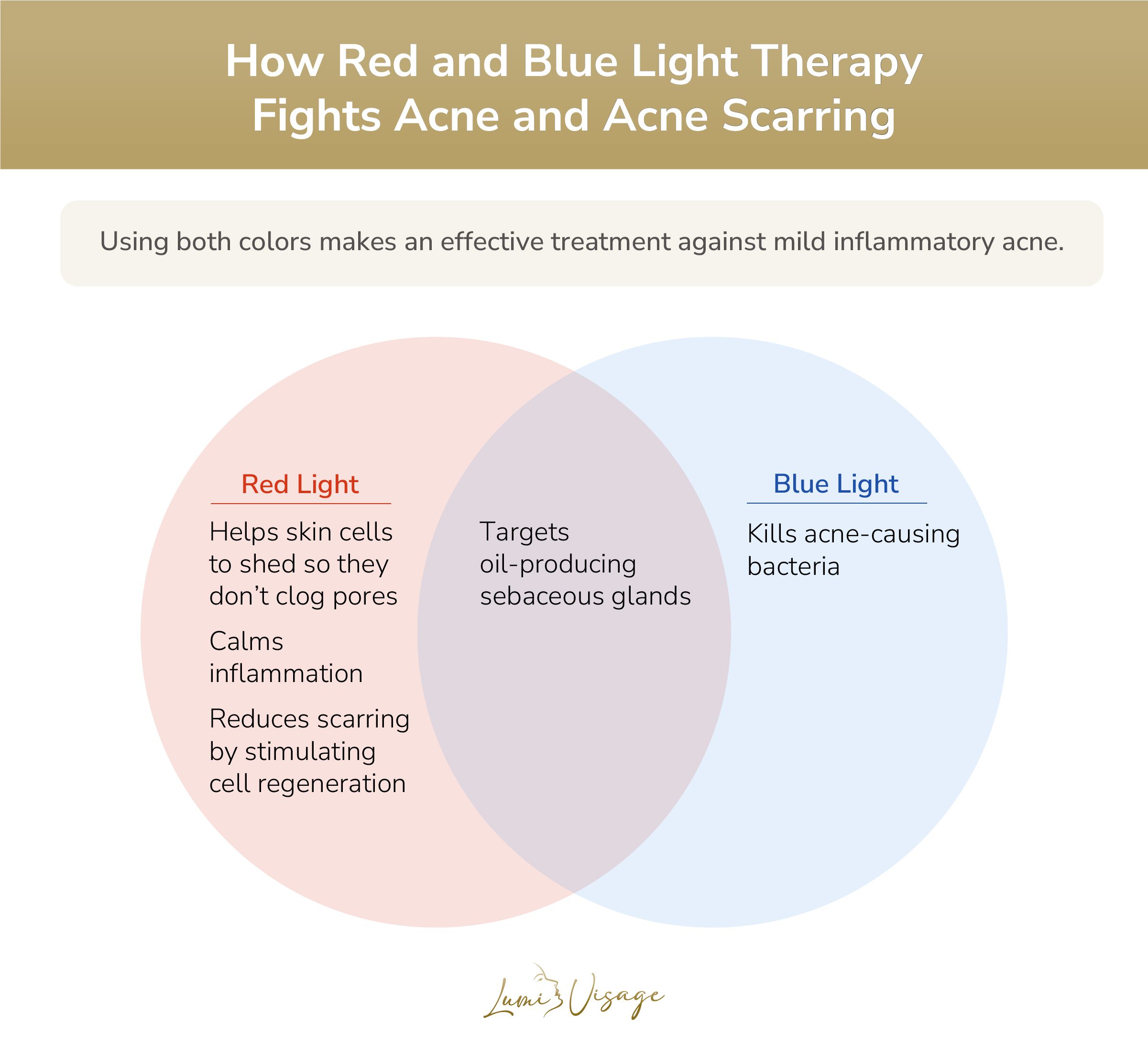
With so many possible causes of acne, it’s best to find a treatment option that covers every possible angle of the problem. Red and blue light therapy work by not only reducing inflammation, but also improving the scarring that can result from breakouts.
Although red light penetrates the deepest, using blue light helps round out the attack against acne. These next sections go over some of the specific ways these special wavelengths of light can help.
Kills acne-causing bacteria
Blue light therapy treats acne by killing acne-causing bacteria, called Propionibacterium acnes, on the surface of the skin. These bacteria produce macromolecules called porphyrins, which absorb the blue light and become activated to release active molecules called free radicals that destroy the bacteria. One study showed that when the bacteria is treated with blue light, the porphyrins produced by bacteria absorb this light, disrupting the cell’s normal process, so that the cell’s products actually kill the bacteria and could help to overcome bacterial resistance.
Targets sebaceous glands to produce less oil
When your sebaceous glands overproduce sebum, this oil can clog your pores. This extra oil can also bind to dead skin cells in your pores, making it hard for them to shed and thus clogging your pores. Red light therapy targets oil-producing glands directly, helping to reduce gland size and limit their function so that sebum production is normalized.
Helps skin cells to shed so they don’t clog pores
When keratinocytes, the skin cells that line your follicles, bind together with hair and sebum, your dead skin cells can’t shed. This causes hyperkeratinization, clogging your pores. Blue light therapy fights hyperkeratinization, helping your skin cells shed normally.
Calms inflammation
When acne forms, your immune system reacts like it’s an attack on your body. It responds by sending out inflammatory mediators to help you heal. But these mediators, while trying to help, often boost the inflammation, redness, and soreness you already experience with acne. Red and blue light can help calm down inflammation and reduce these symptoms.
Reduces scarring by stimulating cell regeneration
When breakouts heal, they can leave behind scars, especially if you’re dealing with severe acne or you pick at or squeeze your pimples. By stimulating collagen production, red light therapy helps reduce the appearance of scars, and promotes better wound healing so you’re less likely to get scars from future breakouts.
An immune response compromises the quality of your collagen — your body still produces collagen to heal your acne, but its fibers are built differently, in a disorganized fashion. Red light therapy stimulates the mitochondria, the “powerhouse” in your skin cells, which encourages the normal, basketweave collagen production in your skin’s thickest layer, called the dermis. This builds collagen in a more organized way, resulting in smoother, less blemished skin.
Can Other LED Light Therapy Colors Help?
While red and blue light are some of the best wavelengths for the treatment of acne, yellow light can also combat acne and help with scarring. Yellow light can increase adenosine triphosphate (ATP) production, a key factor in skin regeneration. Inflammation tends to make acne look worse, but one study that used yellow light reported that it helped reduce inflammation for some patients.
An LED light therapy device, like our LED Face Mask, often comes with a full spectrum of colors, so you can use different colors of light treatment to find other ways to treat your acne and benefit your skin. You can also combine light therapy with other skin care treatments to maintain and enhance your results.
How Long Does Light Therapy Take to Work?
As with any treatment, you have to use light therapy consistently to get the best results. If you’re using an at-home product, there should be treatment instructions in your product’s guidelines.
You can use our mask for 10-minute sessions three to four times per week. While some people see results quickly, you can expect to see results anywhere from one month to three months.
At-Home vs. In-Office LED Light Therapy Treatment for Acne
While you can get LED light therapy in a medical office, you can also safely enjoy skin rejuvenation from the comfort of your home with an at-home device.
There are pros and cons to each choice. While you might see results faster in the office, treating at home can be easier and more cost-effective in the long run, meaning you’ll have better results in the end.
To help you decide the best treatment option for you, here are some of the pros and cons of each.
| At-Home LED Treatment | In-Office LED Treatment | |
| Cost | More affordable | More expensive |
| Consistency | Easier to fit into your daily/weekly routine | Have to set up and attend an office visit for each treatment |
| Strength of treatment | Effective but milder for safety reasons | Stronger since done in a professional setting |
| Results | Takes longer to see results because of the strength | Faster results due to strength |
Using Light Therapy with Other Acne Treatments
LED light therapy is a safe, effective addition to your current skincare regimen. Combining it with other skin treatments, like actives and topicals, can even enhance your results and make clear skin easier to maintain.
Just make sure to check with your dermatologist first, especially if you’re taking prescription medications. Also, before you do LED light therapy, make sure you have a fresh, clean, dry face, so no skincare products applied.
Here are some acne treatments you can try:
- Salicylic acid: Whether it’s in a cleanser, cream, or ointment, salicylic acid is a common ingredient in acne treatments. Combining it with light therapy is proven to achieve faster results than using either treatment on its own.
- Retinoids: Retinoids refer to acne topicals for your skin that include vitamin A. They help unclog pores and promote cell turnover. If you use it after light therapy, it’s an effective double treatment to enhance your results.
- Benzoyl peroxide: Another common ingredient in acne treatments, benzoyl peroxide can also be used safely with light therapy, and is more effective for acne treatment when used in conjunction with it.
Light Therapy Safety Tips
LED light therapy is a generally safe treatment and can be used on all skin types. Just make sure you follow the instructions for using your device as well as these safety tips:
- Consult with your doctor first. You should check in with your doctor if:
- You experience any skin irritation or discomfort. Treatments can impact people differently. If you experience any kind of irritation from LED light therapy, stop treating and consult with your doctor.
- Your doctor has already given you specific treatment or topical medication, whether OTC or not. Check to see if you can add light therapy into your treatment regimen. You may be able to layer or alternate these treatments, and your doctor can help you figure out how to do that safely. But don’t do LED light therapy if you’re taking Accutane.
- Cleanse your skin before use. To ensure the light penetrates your skin as it should, use the device with clean, dry skin.
- Clean the device after use. Since bacteria can cause acne or make breakouts worse, be sure to stop bacteria before it can accumulate from regular use. Just wipe the device with a little soap and water to prevent the build-up of bacteria.
- Moisturize your skin. If you experience dryness, discuss a good moisturizer to use with your doctor so that you don’t add unnecessary oil to your skin.
- Use a device that is FDA-cleared and has eye protection. Although good for your skin, your eyes need protection. The Lumivisage LED face mask has built-in eye protection goggles and is FDA-cleared, so you can trust it’s completely safe to use.
Try LED Light Therapy to Use at Home
Whether it’s from hormones, stress, or a late-night sugar binge, we all fall victim to the occasional bad breakout. The next time your acne rears its ugly head, try giving your skin a healthy dose of red and blue light to stop that breakout in its tracks.
If you’re not sure about in-office treatments, an at-home device, like our LED Light Mask, is a gentle, yet effective, and affordable way to reap the benefits of LED therapy without ever having to leave the house.
References
Indian Dermatology Online Journal. “Light-based therapies in acne treatment.” https://www.ncbi.nlm.nih.gov/pmc/articles/PMC4439741/. Date accessed: September 28, 2023.
FEMS Immunology & Medical Microbiology. “Eradication of Propionibacterium acnes by its endogenic porphyrins after illumination with high intensity blue light.” https://academic.oup.com/femspd/article/35/1/17/528711. Date accessed: September 28, 2023.
Archives of Dermatological Research. “Regulation of lipid production by light-emitting diodes in human sebocytes.” https://pubmed.ncbi.nlm.nih.gov/25690162/. Date accessed: September 28, 2023.
The Journal of Investigative Dermatology. “Blue-light irradiation regulates proliferation and differentiation in human skin cells.” https://pubmed.ncbi.nlm.nih.gov/19675580/. Date accessed: September 28, 2023.
Journal of American Academy of Dermatology. “Low-level red and infrared light increases expression of collagen, elastin, and hyaluronic acid in skin.” https://www.jaad.org/article/S0190-9622(19)33160-3/fulltext. Date accessed: September 28, 2023.
The Journal of Clinical and Aesthetic Dermatology. “Light-emitting Diodes.” https://www.ncbi.nlm.nih.gov/pmc/articles/PMC4479368/. Date accessed: September 28, 2023.
The Open Dermatology Journal. “Efficacy of Supramolecular Salicylic Acid 30% Combined with Intense Pulsed Light Compare to Monotherapy Supramolecular Salicylic Acid 30% in Acne Vulgaris Patients.” https://opendermatologyjournal.com/VOLUME/17/ELOCATOR/e187437222301300/FULLTEXT/#:~:text=of%20our%20finding.-,CONCLUSION,but%20also%20improves%20skin%20rejuvenation. Date accessed: September 28, 2023.
Journal of Research in Pharmacy Practice. “Efficacy of Intense-pulsed Light Therapy with Topical Benzoyl Peroxide 5% versus Benzoyl Peroxide 5% Alone in Mild-to-moderate Acne Vulgaris: A Randomized Controlled Trial.” https://www.ncbi.nlm.nih.gov/pmc/articles/PMC5787904/. Date accessed: September 28, 2023.