



Yellow light therapy is a type of light-emitting diode (LED) light therapy, a non-invasive treatment that can help with a variety of skin conditions. While red and blue light are two of the most commonly studied and well-known wavelengths, yellow LED light therapy has its own competitive benefits.
You can get LED light therapy in-office, like at a dermatologist, or do it yourself with a specialized at-home device. The Lumivisage LED Light Therapy Mask emits yellow light at 560 nm, which works to reduce inflammation, even out skin tone and pigmentation issues, and reduce signs of aging.
In this post, we go over the benefits of yellow light therapy, including how it compares to other therapeutic wavelengths, and how to get the best results for your skin.
Table of Contents
- How Does Yellow Light Therapy Work?
- The Benefits of Yellow Light Therapy
- Yellow Light vs. Red and Blue Light Therapy
- Are There Any Risks to Yellow Light Therapy?
- How Often Should You Do Yellow Light Therapy?
- How to Choose a Yellow Light Therapy Device
- Try Yellow Light Therapy at Home with Lumivisage
How Does Yellow Light Therapy Work?
Like other LED wavelengths, yellow light therapy works by penetrating the skin past the epidermis to induce a cellular response. Different colors penetrate the skin to different depths, and have varying effects on your cells and tissues. This is why each color has unique benefits.
Yellow light, which is different from amber light, has a wavelength of about 560 nm to 590 nm, and penetrates skin from 0.5 to 2 mm deep at the dermis (middle) layer.
When yellow light penetrates the skin, it increases the production of ATP (adenosine triphosphate), a molecule that stores and transfers energy in cells. Your body uses ATP to combat inflammation and regenerate skin cells. Yellow light also reduces tyrosinase, a component of melanin production and decreases melanin content and maturation of melanin containing bodies (melanosomes), which help fight hyperpigmentation.
The Benefits of Yellow Light Therapy
Treating your skin with yellow light therapy can help with many skin concerns. Here are some of its main benefits for skin health.
Combats Inflammation and Reduces Erythema
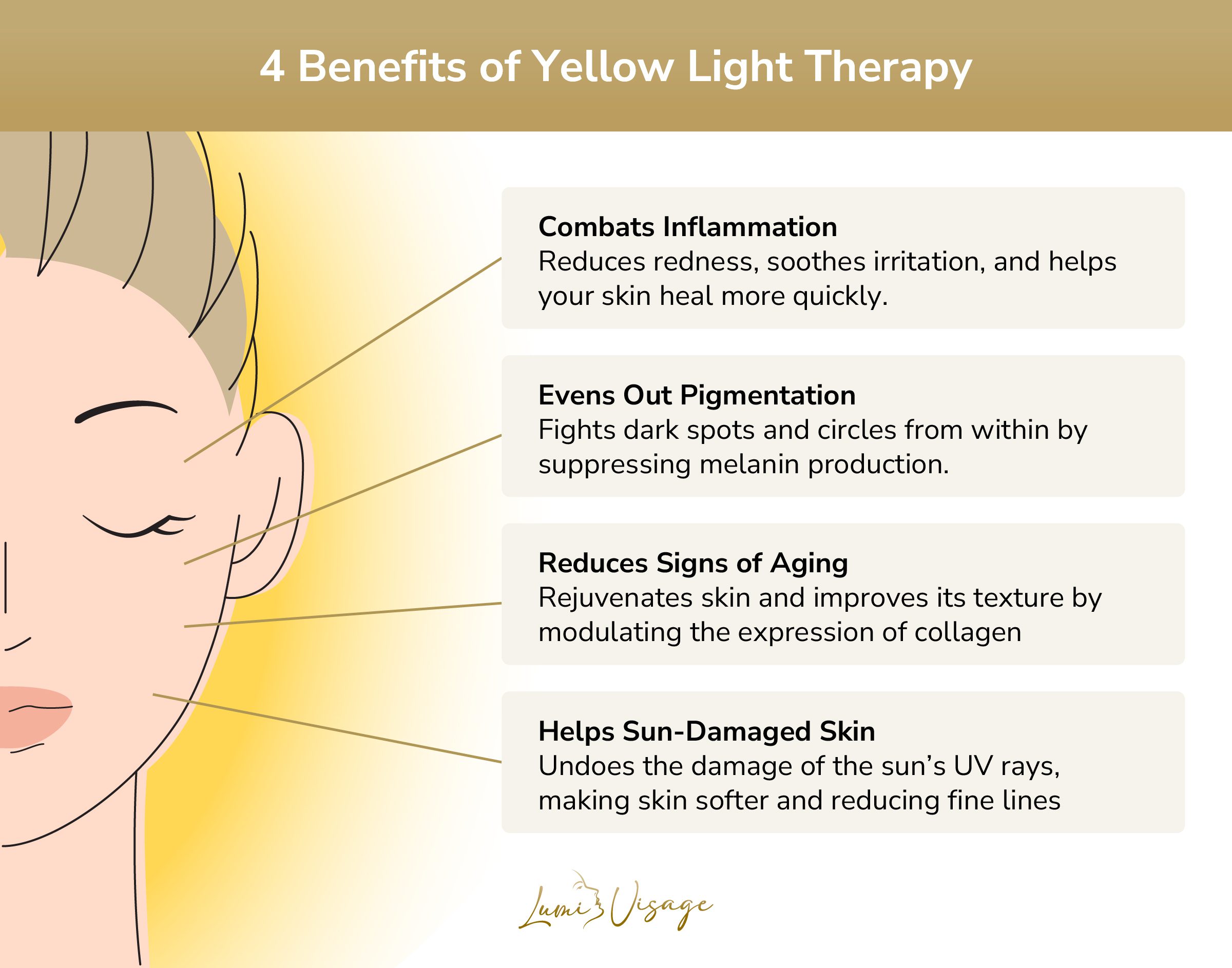
By calming inflammation in your cells, through inhibiting one of inflammatory mediators called vascular endothelial growth factor (VEGF), yellow light can reduce redness, soothe irritation, and help your skin heal more quickly, especially when you use yellow light after some procedures, such as fractional laser and IPL treatments.
Evens Out Pigmentation
Yellow light is a great treatment option for hyperpigmentation, a condition where some parts of the skin are darker than others.
Hyperpigmentation is caused by an increase in melanin, a pigment made by skin cells called melanocytes. Yellow light fights hyperpigmentation from within by reducing the production of the protein tyrosinase, a component of melanin synthesis.
Yellow light can also suppress melanin production by stopping melanosomes, the organelles that synthesize melanin and store it, from maturing. If they don’t mature, they won’t produce melanin.
This wavelength of light could also be a therapeutic option in the treatment of melasma through inhibited microvascular endothelial cell (HMEC-1) migration, which play a role in blood vessel formation, tube formation (the process by which these cells form blood vessels), and the secretion of VEGF (vascular endothelial growth factor) and SCF (stem cell factor), both of which are proteins that promote blood vessel growth. It does all of this predominantly through the inhibition of the AKT/PI3K/mTOR pathway, a complex signaling pathway that regulates cell growth, proliferation, and survival.
The cosmetic result is fewer dark spots on your skin. That means yellow light can help things like dark spots, sun spots, and even under-eye dark circles, if they’re caused by pigment issues.
Reduces Signs of Aging and Improves Skin Texture
Yellow light is also a great tool for general skin rejuvenation. Studies show it can reduce signs of aging, increase blood flow, and improve skin texture by modulating the expression of collagen and matrix metalloproteinases (MMPs) in skin.
Collagen and MMPs are like the building blocks of your skin. They give your skin its firmness, fullness, and ability to rebound from damage like injuries and acne. Increasing their presence in your skin keeps it healthy, youthful, and strong, and helps with skin healing.
MMP and collagen production tends to naturally slow down with age, so yellow light therapy also works as a preventative treatment.
Helps Sun-Damaged Skin
Yellow light therapy can also help heal sun damage. In one study on 900 patients with photoaged skin, yellow LED light was used either alone or with other types of light or laser treatments. The patients who only received the LED treatment reported their skin was softer and they had fewer fine lines.
Another study on 93 patients found that photoaging decreased by an entire wrinkle class in 90% of subjects together with reduction of global skin texture, background erythema, and pigmentation. And in another study on 90 patients, 100% showed an increase in collagen, which helps promote younger-looking skin.

Yellow Light vs. Red and Blue Light Therapy
If you’ve heard the buzz about red and blue, you may be wondering if yellow light is more or less effective than other LED light therapy colors.
In general, no one color is more effective overall. Each wavelength of light acts on a specific layer or aspect of skin, so they each have their own unique benefits and use cases.
Also, LED light colors are often used in combination. While red LED light therapy and blue LED light therapy are offered as separate treatments, combining them in a single treatment or doing one after the other can give you an even bigger bang for your buck.
Yellow vs. Red Light Therapy
Red light penetrates the skin more deeply than yellow light, reaching the deep dermal to subcutaneous layer (2 to 3 mm). This means red light has stronger anti-aging benefits, since it can stimulate the production of elastin and hyaluronic acid, which affect the stretchiness and moisture content of your skin.
Studies on red and near-infrared light therapy point to additional benefits, like improving blood circulation and wound healing.
Like yellow light, red light can help boost collagen production. It can also reduce skin redness by soothing inflammation, helping inflammatory skin conditions like rosacea.
Yellow vs. Blue Light Therapy
Blue light also penetrates skin to the dermis layer, but not quite as deeply (<1mm) as yellow light. It’s mainly used as an effective acne treatment.
Blue light can kill acne-causing bacteria on the skin, keeping breakouts at bay. It also slows down activity in the sebaceous glands, helping your skin produce less oil which can reduce blemishes.
Are There Any Risks to Yellow Light Therapy?
LED light skin treatments are generally safe for all skin types. When it’s used properly, yellow light therapy is as safe as any other color, and can be a regular part of your skincare routine.
However, there might be some risks if you’re not a candidate for LED light therapy, or if you use your device incorrectly.
For example, you shouldn’t use yellow light or any other color if:
- You have a weakened immune system.
- You take medications that cause photosensitivity.
- You have had cosmetic surgery or skin-related procedures in the last two months.
Make sure to use your device according to the manufacturer’s guidelines. Each LED light therapy device will come with specific instructions for safe use. These guidelines apply to most light treatment devices:
- Use the device for only 10 minutes per session.
- Stop use if the device gets too hot.
- Use eye protection and don’t look directly at the light when the device is on. The Lumivisage Face Mask contains built-in eye protection to keep your eyes safe during treatment.
- Don’t use the device after shaving.
- Stop use and consult your doctor if you experience any side effects, like skin irritation.
How Often Should You Do Yellow Light Therapy?
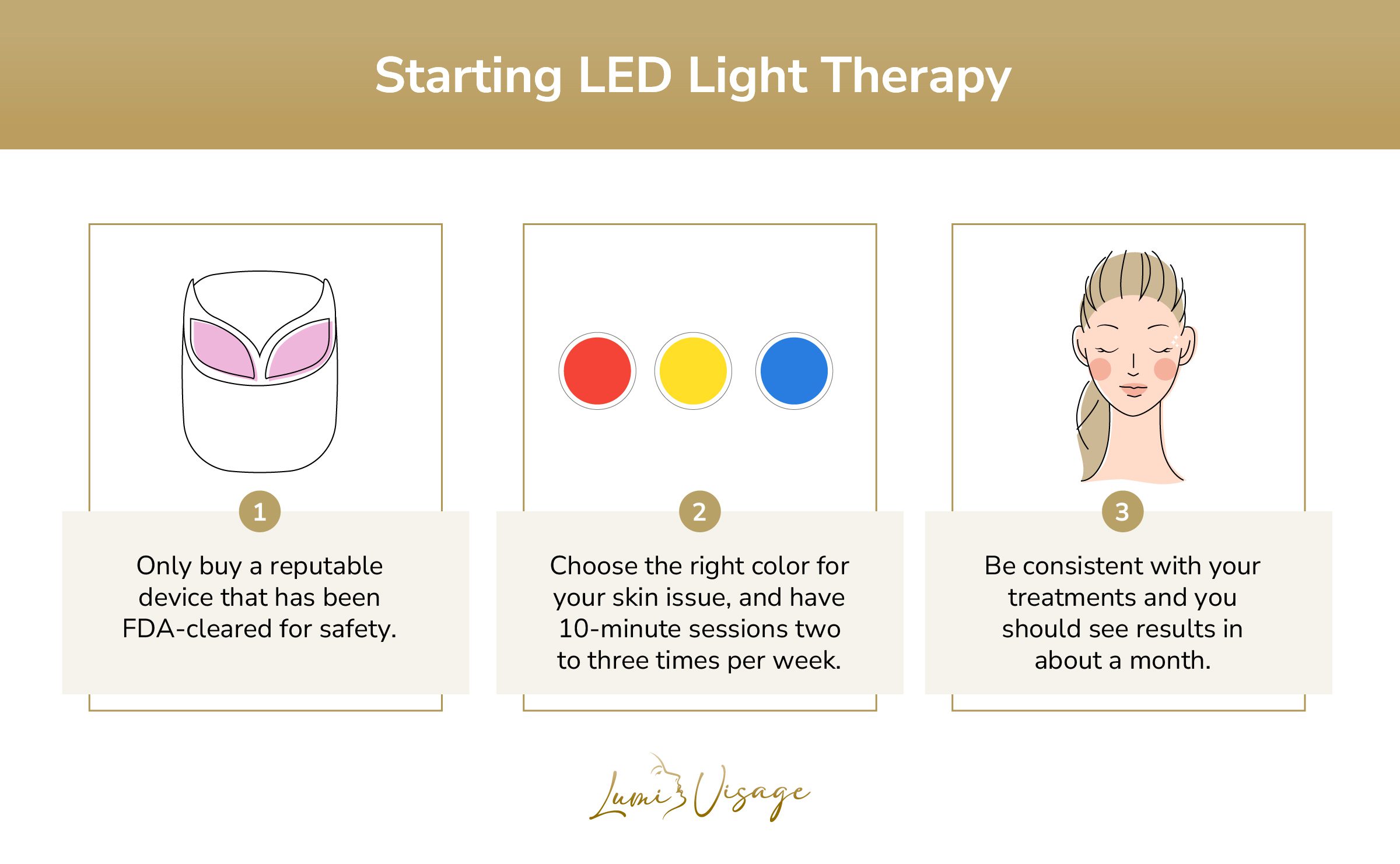
For the best results, use your LED face mask for 10-minute sessions two to three times per week. It may take at least four to five weeks of consistent use to see results in your skin’s appearance.
If you’re using multiple colors, you could either do two five-minute sessions, or use each one twice a week, or the equivalent depending on how many colors you want to use.
In general, your LED mask is safe to use every day. You can increase or decrease the frequency of light treatments based on your own skin issues and needs.
How to Choose a Yellow Light Therapy Device
With so many different yellow light therapy devices on the market, it can be difficult to know which to choose.
For treating the skin on your face, an LED face mask is a good option. In addition to helping with skin concerns like sun damage, redness, or dark spots, using a mask for yellow light therapy is a good way to relax and unwind, and carve out some regular time for self-care.
The most important thing to check for with any device is whether it’s FDA-cleared. FDA clearance means it has been rigorously tested, is safe to use, and offers the benefits it promises. The Lumivisage LED Face Mask is FDA-cleared, so you can be sure you’re getting the quality of treatment you expect.
You can also look for specific features depending on your needs, like a range of LED colors, or safety features like built-in eye protection. The Lumivisage Face Mask offers both a wide color range and protection for your eyes.
Try Yellow Light Therapy at Home with Lumivisage
Yellow light therapy is a safe, easy addition to any beauty routine. Simply relax with your LED face mask and let the wavelength work its magic on your skin.
If you’re ready to see what LED light therapy can do for you, the Lumivisage LED Face Mask is a great place to start. In just 10 minutes a day, three to four times a week, you can achieve more beautiful skin, all from the comfort of your home.
References
Journal of Dermatological Science. “Light-emitting diode 585nm photomodulation inhibiting melanin synthesis and inducing autophagy in human melanocytes.” https://pubmed.ncbi.nlm.nih.gov/29065997/. Date accessed: December 11, 2023.
The Journal of Clinical and Aesthetic Dermatology. “Light-emitting Diodes.” https://www.ncbi.nlm.nih.gov/pmc/articles/PMC4479368/. Date accessed: December 11, 2023.
Journal of Dermatological Science. “Light-emitting diode 585nm photomodulation inhibiting melanin synthesis and inducing autophagy in human melanocytes.” https://pubmed.ncbi.nlm.nih.gov/29065997/. Date accessed: January 24, 2024.
Cells. “590 nm LED Irradiation Improved Erythema through Inhibiting Angiogenesis of Human Microvascular Endothelial Cells and Ameliorated Pigmentation in Melasma.” https://www.ncbi.nlm.nih.gov/pmc/articles/PMC9776419/#:~:text=The%20pathogenesis%20of%20melasma%20is,PBM. Date accessed: January 24, 2024.
Clinical and Experimental Dermatology. “Skin photorejuvenation effects of light-emitting diodes (LEDs): a comparative study of yellow and red LEDs in vitro and in vivo.” https://pubmed.ncbi.nlm.nih.gov/27663159/. Date accessed: December 11, 2023.
Dermatologic Surgery. “Clinical experience with light-emitting diode (LED) photomodulation.” https://pubmed.ncbi.nlm.nih.gov/16176771/. Date accessed: January 24, 2024.
Journal of Drugs in Dermatology. “A novel non-thermal non-ablative full panel LED photomodulation device for reversal of photoaging: digital microscopic and clinical results in various skin types.” https://pubmed.ncbi.nlm.nih.gov/15624743/. Date accessed: December 11, 2023.
Lasers in Surgery and Medicine. “Clinical trial of a novel non-thermal LED array for reversal of photoaging: clinical, histologic, and surface profilometric results.” https://pubmed.ncbi.nlm.nih.gov/15654716/. Date accessed: December 11, 2023.
Free Radical Biology and Medicine. “Red/Near Infrared Light Stimulates Release of an Endothelium Dependent Vasodilator and Rescues Vascular Dysfunction in a Diabetes Model.” https://www.ncbi.nlm.nih.gov/pmc/articles/PMC5699925/. Date accessed: December 11, 2023.
Journal of Cosmetic Laser Therapy. “Red light-emitting diode (LED) therapy accelerates wound healing post-blepharoplasty and periocular laser ablative resurfacing.” https://pubmed.ncbi.nlm.nih.gov/16581685/. Date accessed: December 11, 2023.
Journal of American Academy of Dermatology. “Low-level red and infrared light increases expression of collagen, elastin, and hyaluronic acid in skin.” https://www.jaad.org/article/S0190-9622%2819%2933160-3/fulltext. Date accessed: December 11, 2023.
Experimental Dermatology. “Light-emitting diodes downregulate cathelicidin, kallikrein and toll-like receptor 2 expressions in keratinocytes and rosacea-like mouse skin.” https://pubmed.ncbi.nlm.nih.gov/27315464/. Date accessed: December 11, 2023.
Archives of Dermatological Research. “Regulation of lipid production by light-emitting diodes in human sebocytes.” https://pubmed.ncbi.nlm.nih.gov/25690162/. Date accessed: December 11, 2023.