

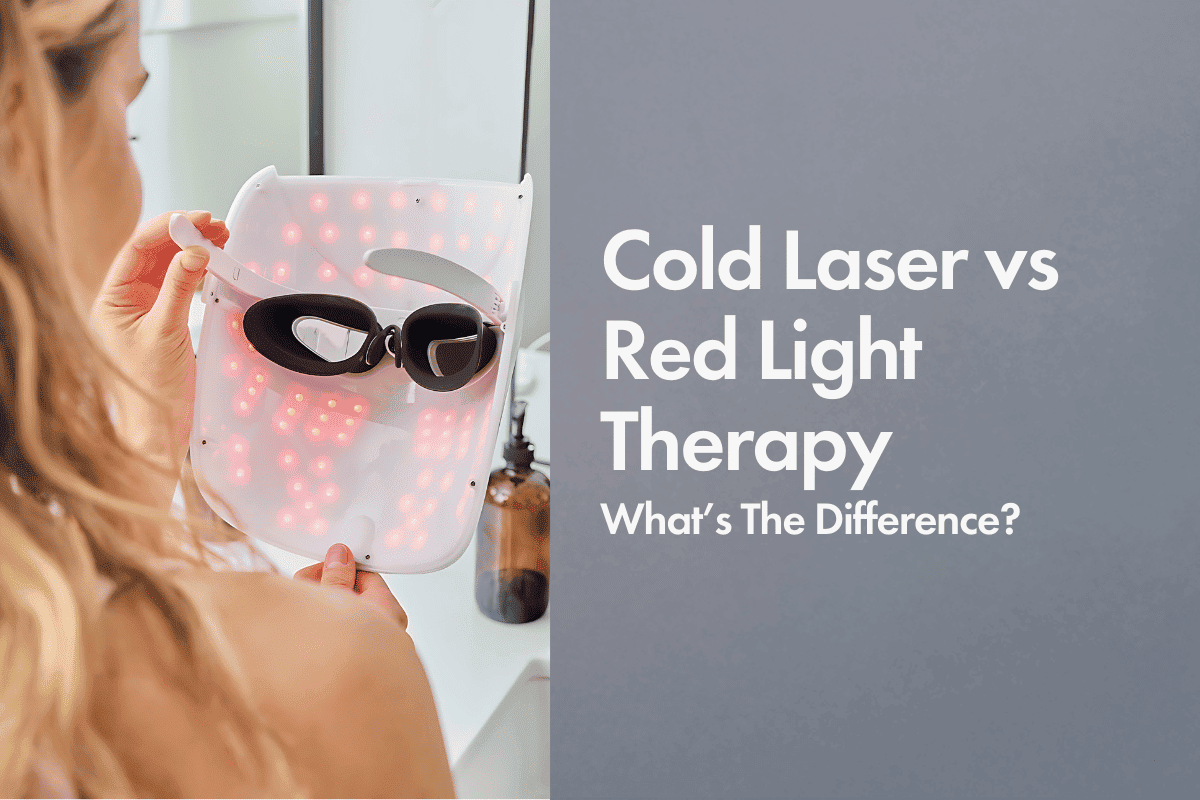

Cold laser therapy and red light therapy both speed up healing, but they work in completely different ways.
One dives deep to repair muscles and nerves, while the other boosts skin, circulation, and inflammation relief.
If you’re wondering which one actually fits your needs, keep reading—because choosing the right treatment can make all the difference.
- Cold laser therapy penetrates deeper, making it ideal for muscles, joints, and nerve pain.
- Red light therapy targets skin, inflammation, and surface-level healing with LED technology.
- Cold lasers use focused beams, while red light therapy relies on broad-spectrum LEDs.
- Both therapies boost cellular energy (ATP) to speed up healing and reduce inflammation.
Differences Between Cold Laser and Red Light Therapy
| Feature | Red Light Therapy | Cold Laser Therapy |
|---|---|---|
|
Light Source |
LED panels or handheld devices |
Low-intensity laser beams |
|
Wavelengths |
630-700nm (red) & 810-850nm (NIR) |
600-1000nm |
|
Penetration Depth |
Shallow to moderate |
Deeper, reaching muscles and nerves |
|
Best For |
Skin, surface-level healing, mild pain relief |
Deep tissue repair, chronic pain, nerve health |
|
Common Uses |
Acne, wrinkles, muscle soreness, wound healing |
Arthritis, tendon injuries, post-surgical recovery |
|
Side Effects |
Minimal (mild warmth or redness) |
Rare, but requires trained use |
Understanding Light-Based Therapies
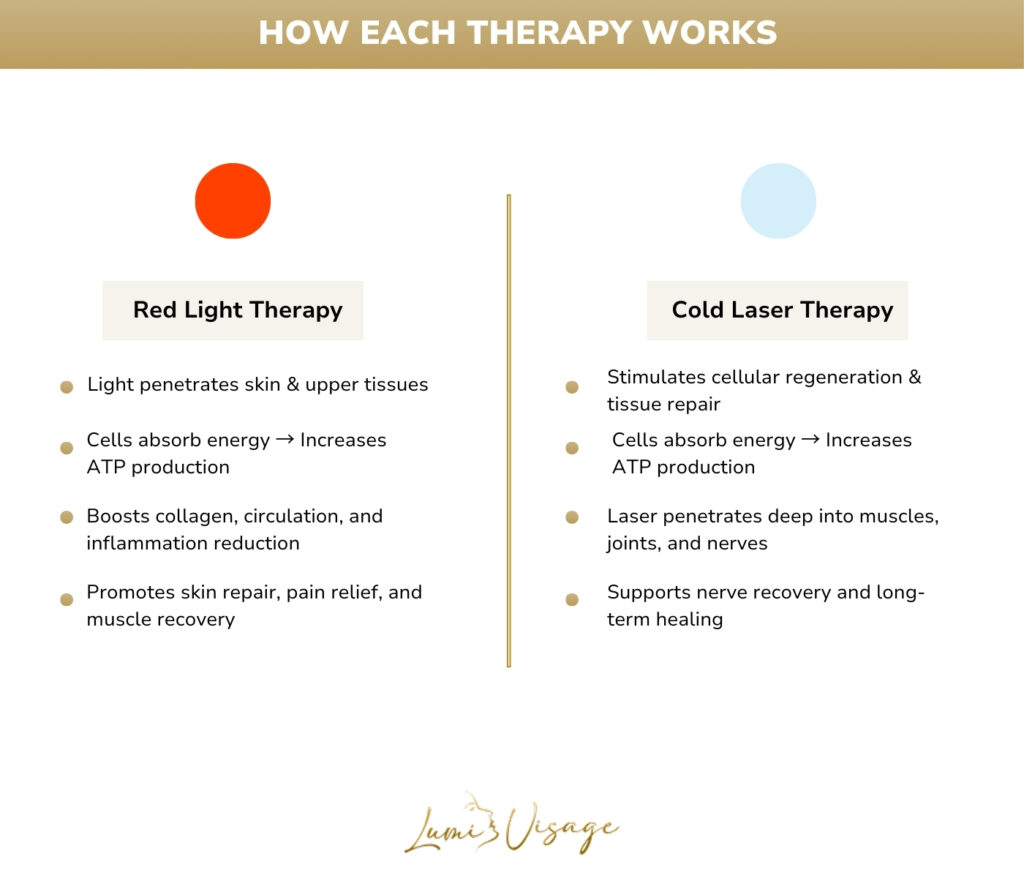
Both cold laser therapy and red light therapy fall under photobiomodulation (PBM)—a process where specific light wavelengths interact with cells to promote healing and reduce inflammation.
How It Works
When light energy enters the body, it’s absorbed by mitochondria, the powerhouse of cells.
This leads to an increase in adenosine triphosphate (ATP) production, which gives cells more energy to repair and regenerate.
Different wavelengths penetrate at different depths, affecting how the therapy works and what conditions it treats.
What Is Red Light Therapy?
Red light therapy (RLT) uses low-wavelength red and near-infrared (NIR) light to improve skin health, reduce inflammation, and accelerate healing.
Key Features of Red Light Therapy
- Wavelengths: Typically 630-700nm for red light and 810-850nm for near-infrared light.
- Light Source: LED panels, masks, or handheld devices.
- Penetration Depth: Shallow to moderate—ideal for skin, muscles, and surface-level healing.
- Uses: Skin rejuvenation, wound healing, inflammation reduction, and mild pain relief.
How Red Light Therapy Helps
- Boosts collagen production – Improves skin elasticity and reduces wrinkles.
- Speeds up healing – Supports tissue repair and reduces scar formation.
- Reduces inflammation – Helps conditions like arthritis and joint pain.
- Enhances circulation – Delivers more oxygen and nutrients to damaged cells.
Common Applications
- Skincare – Treats acne, wrinkles, and sun damage.
- Pain Relief – Reduces joint and muscle soreness.
- Wound Healing – Speeds up recovery from cuts, burns, and injuries.
What Is Cold Laser Therapy?
Cold laser therapy—also called low-level laser therapy (LLLT)—uses focused laser beams instead of LEDs to stimulate deep tissue healing and pain relief.
Key Features of Cold Laser Therapy
- Wavelengths: Typically 600-1000nm, depending on the target tissue.
- Light Source: Low-intensity lasers.
- Penetration Depth: Deeper than red light therapy—effective for muscles, tendons, and nerves.
- Uses: Chronic pain, deep tissue injuries, and musculoskeletal conditions.
How Cold Laser Therapy Helps
- Relieves pain – Used for arthritis, carpal tunnel, and back pain.
- Reduces inflammation – Helps with tendonitis, bursitis, and joint swelling.
- Accelerates tissue repair – Speeds up healing in ligaments, tendons, and muscles.
- Promotes nerve regeneration – Beneficial for conditions like neuropathy.
Common Applications
- Sports Injuries – Used to treat muscle strains, ligament tears, and joint pain.
- Post-Surgical Recovery – Helps with healing and reducing post-op swelling.
- Chronic Pain Management – Often used for fibromyalgia and nerve damage.
Safety and Side Effects
Both cold laser therapy and red light therapy are considered safe, non-invasive, and drug-free.
However, there are some differences in potential side effects:
Red Light Therapy Safety
- Safe for daily use with no known long-term risks.
- Mild warmth or slight redness may occur in sensitive individuals.
- Avoid direct eye exposure to high-powered LED panels.
Cold Laser Therapy Safety
- Requires trained professionals for proper application and dosage control.
- Not recommended for cancerous tissues, as it may stimulate cell growth.
- Should not be used directly over the thyroid or reproductive organs without medical supervision.
Choosing the Right Therapy for Your Needs
The best therapy for you depends on what condition you’re treating and how deep the issue is.
Choose Red Light Therapy If:
- You want skin benefits like collagen production, anti-aging, or acne reduction.
- You have surface-level injuries like cuts, burns, or mild muscle soreness.
- You need a safe, at-home therapy option for general wellness.
Choose Cold Laser Therapy If:
- You have chronic pain conditions like arthritis or sciatica.
- You need deep tissue repair for tendons, ligaments, or nerves.
- You’re treating serious injuries under professional supervision.
For some conditions, both therapies can complement each other. For example, red light therapy can reduce swelling and improve circulation, while cold laser therapy targets deeper damage for complete healing.
Struggling With Dull Skin Or Stubborn Inflammation?
Red light therapy restores, heals & gives your skin a healthy glow

Frequently Asked Questions
Can cold laser therapy and red light therapy be used together?
Yes! Many clinics and professionals combine both treatments—cold laser for deep tissue repair and red light for reducing inflammation and improving circulation.
Is cold laser therapy stronger than red light therapy?
Not necessarily. Cold laser therapy penetrates deeper, but red light therapy can cover a larger treatment area and is often used more frequently.
Do cold lasers get hot during treatment?
No, despite the name, cold lasers do not generate heat. They work at low intensities, so there’s no risk of burns or discomfort.
Can either therapy help with nerve damage?
Cold laser therapy is often used for neuropathy and nerve regeneration, while red light therapy helps with inflammation-related nerve pain.
How long does it take to see results from these therapies?
It varies. Some people notice pain relief after a few sessions, while deeper healing (like tendon or nerve repair) can take weeks to months of consistent use.
Are there any conditions that shouldn’t be treated with these therapies?
Both are generally safe, but cold laser therapy should not be used over cancerous tumors, and red light therapy should be used cautiously by those with light-sensitive conditions.
Conclusion
Cold laser therapy and red light therapy both boost healing, but they serve different purposes.
Cold laser therapy penetrates deep into muscles, joints, and nerves, making it ideal for pain relief and injury recovery. Red light therapy focuses on skin health, inflammation, and circulation, making it perfect for everyday wellness and beauty.
If you’re looking for an easy, at-home way to reduce inflammation, boost collagen, and improve your skin, red light therapy is a smart choice. Our 7-Color LED Face Mask delivers red and near-infrared light therapy to help your skin heal, glow, and stay healthy.
Get yours today and experience the benefits firsthand!