

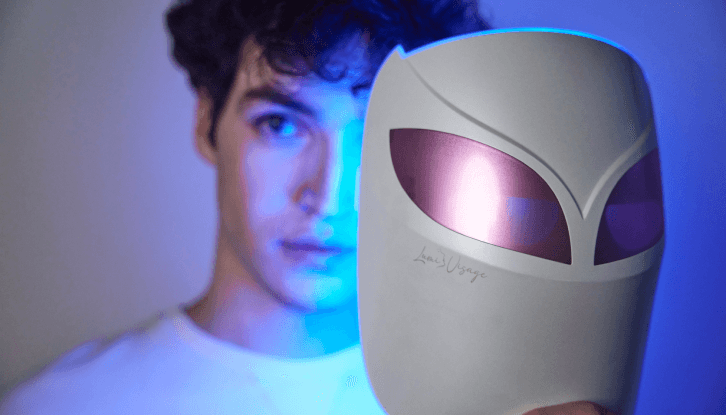

LED face masks are clinically proven to improve your skin. Their benefits include antiaging and acne treatment. In this post, we explain how LED face masks work, how to use them, and all the skin benefits you can achieve by using one.
Table of Contents
- Do At-Home LED Face Masks Really Work?
- How LED Light Therapy Works
- What Issues Can LED Therapy Help With?
- Are LED Face Masks Safe?
- How Often Should I Use an LED Face Mask?
- How to Use an LED Face Mask for the Best Results
- Is an LED Mask Worth Buying?
- Try LED Light Therapy at Home with Lumivisage
Do At-Home LED Face Masks Really Work?
Yes, LED face masks actually work, and they’re safe and effective to use at home. A clinical study assessed the safety and efficacy of a daily treatment with the home-use device for 28 days. A significant increase in skin density and radiance was obtained while reducing wrinkles. Patients did not experience side effects.
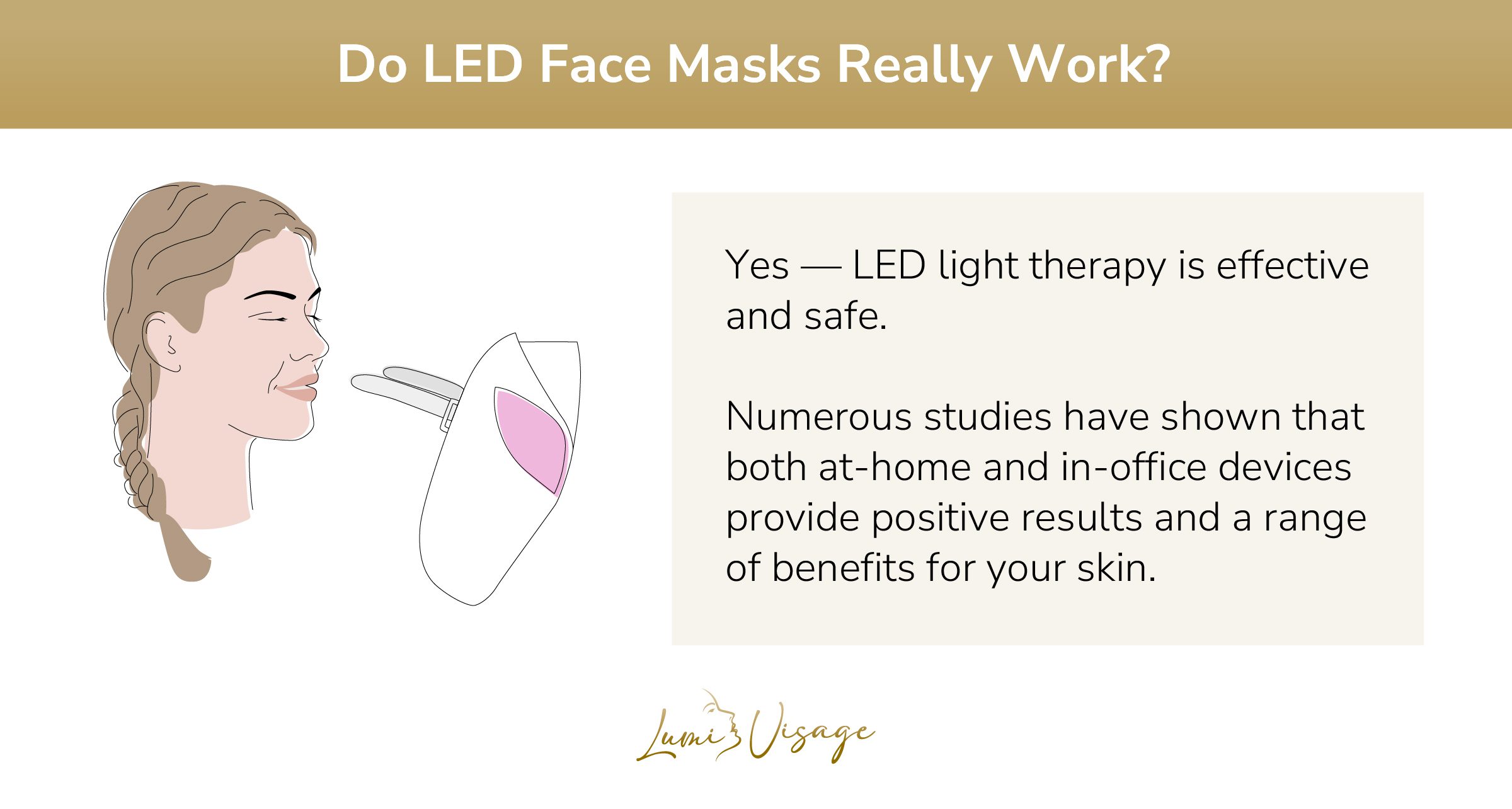
At-home LED face masks are:
- Cheaper than the ones used by the dermatologist’s office (although less powerful)
- Easily incorporated into your everyday skincare routine at home
- FDA-cleared, so you know you will be safe during use
Multiple studies have shown favorable results including:
- Improved skin complexion: In one controlled trial, subjects treated with red and near-infrared light twice a week significantly improved their skin complexion compared to a control group. In another study that examined the effectiveness of small handheld devices when treating photodamaged skin, subjects saw complexion results after eight weeks of treatment using both red and infrared light. Seventy-four percent reported seeing visible improvement in their fine lines and wrinkles.
- Acne treatment: In one study, 22 patients showed a significant decrease in acne lesions after being treated with red and blue light therapy over eight sessions, with two per week. Another study evaluated the efficacy of blue light devices used at home for treating acne. Results showed rapid improvement in inflammatory signs within one week, which reflected its use as an alternative treatment to topicals and antibiotics or in addition to other modalities.
- Reduced inflammation: In an animal study, mice showed red light and near-infrared light reduced the inflammatory mediators and new blood vessel formation that cause rosacea. Another study searched literature to evaluate how well LED photobiomodulation could treat inflammation, and it showed beneficial effects in controlling inflammation.
How LED Light Therapy Works
LED light therapy uses various colors of light, all of which have different wavelengths, to penetrate your skin. The higher the wavelength, the deeper it can reach into your skin. Each color will react differently with the cells on each layer of skin, yielding various benefits for the user.
The light is absorbed by proteins in the mitochondria, also known as the powerhouse of the cell. Once the light is absorbed by these proteins, the production of ATP, RNA, and proteins is increased. NADH production is also increased, which is important as this is a molecule that stores energy.
All of these cellular responses will improve your skin’s function and repair system. LED light therapy induces your skin to heal itself from the inside, instead of having to use a host of expensive topical creams and gels.
What Issues Can LED Therapy Help With?
LED face masks can give your skin plenty of different benefits, depending on the wavelength and color of light that you use. Here are some of the main skin concerns that LED therapy devices can help with.

Wrinkles and Aging Skin
Red light can reduce wrinkles and fine lines and encourage your skin to undergo more repair processes, creating an anti-aging effect.
Red light causes your skin to produce more hyaluronic acid, collagen, and elastin. More collagen production improves your skin structure to make it look tighter and firmer, with fewer wrinkles. Elastin keeps your skin stretchy, while hyaluronic acid helps your skin stay hydrated, decreasing signs of aging.
Acne and Breakouts
Red and blue light can be used to treat acne. These colors can give you clearer skin, all while working to reduce the potential for breakouts in the future, combatting those nasty dark spots and blemishes.
Blue light kills the acne-causing bacteria on the surface of the skin. It makes your sebaceous glands produce less oil so that your pores won’t clog as much and create pimples. Research showed that people using blue light saw a decrease in pimple size and overall acne breakouts on their skin.
Red light therapy also treats acne by targeting the sebaceous glands. It can reduce the gland size so that less sebum is produced, which leads to less acne being able to form.
Inflammatory Skin Conditions like Rosacea and Eczema
LED treatments can also help target skin conditions like rosacea and eliminate symptoms of eczema.
Red light has been proven to reduce skin redness and swelling. Skin cells exposed to LED red light wavelengths showed less inflammation and eczema activity.
Yellow light also has some of these capabilities. It can decrease erythema, which is a rash due to inflamed capillaries, as well as skin inflammation.
Blue light also showed good results in treating and controlling episodes of atopic dermatitis (a type of eczema) as shown in a study that used blue light to treat full body atopic dermatitis.
Are LED Face Masks Safe?
LED light therapy is completely safe with only minor side effects. On the off chance you do experience those side effects, they should likely disappear within 24 hours. As with any treatment, you should always consult with your doctor or dermatologist first, especially if you experience any of the following:
- You have constant skin irritation.
- You have suspicious or cancerous lesions.
- You have a serious disease or medical condition.
- Your skin condition worsens.
- You have a thyroid-related disease.
You also should not use light therapy if:
- You have a weakened immune system.
- You take drugs that cause sensitivity to light.
- You have had cosmetic surgery or skin-related procedures in the last two months or less.
If you use an at-home device, make sure that it is FDA-cleared and has eye protection like goggles. Follow the device instructions carefully, as you can set yourself up for more risk if you do not use it properly. For example:
- Don’t use the device for too long (10 minutes for the Lumivisage LED Face Mask).
- Don’t continue to use it if the device gets too hot.
- Don’t use the device directly after shaving.
- Don’t look at the light when the device is working (use eye protection).
How Often Should I Use an LED Face Mask?
For best results, use the LED face mask for 10 to 15 minutes up to two to three times a week. If you plan on using different colors, you could split it up to do two 5-minute sessions or alternate treatment by week.
How Long Does an LED Face Mask Take to Work?
Consistency with your LED light therapy leads to better, faster results. The Lumivisage LED Face Mask is designed to be used for 10- to 15-minute sessions, two to three times a week. For best results, you will need to use it regularly for one to three months.
How to Use an LED Face Mask for the Best Results
Here is how you can use an LED face mask, like the Lumivisage LED Face Mask, and achieve optimal results.

Step 1: Prepare Your Skin and the Device
Wash your face to get rid of any oil or makeup from your skin that could be clogging your pores. Pat your face dry — there’s no need to add any product before use. Also, make sure your device is charged and ready to go!
Step 2: Attach the Mask and Relax
Select the color you wish to use, then find a place to do the treatment. Attach the mask so that it sits comfortably on your face and cover your eyes from the light. The Lumivisage LED Face Mask already has built-in eye protection. When you’re set, set a timer for 10 minutes and begin your treatment.
Step 3: Moisturize Your Skin
After your 10 minutes is up, remove your mask and use a moisturizer to help combat dryness. To achieve the best results, try using something that has hyaluronic acid, green tea, or vitamin C as a main ingredient. Then you can continue with your regular skincare products.
Is an LED Mask Worth Buying?
LED light therapy masks that are FDA-approved are a great investment, especially if you plan on using them regularly. These LED devices are cheaper than in-office treatment, and allow you to complete your treatment from the comfort of your own home. If you have a skin condition that could benefit from LED light therapy, using your face mask at home could also boost your self-esteem.
| Advantages | Disadvantages |
|
|
Try LED Light Therapy at Home with Lumivisage
If you’re looking for a reputable LED face mask that will improve your skin condition, look no further than the Lumivisage LED Face Mask. This face mask is FDA-cleared and has built-in eye protection to keep you safe, as well as a whole range of light settings to choose from. Make your skin happy and buy an LED face mask today!
References
Journal of Biophotonics. “Safety and efficacy of a novel home-use device for light-potentiated (LED) skin treatment.” https://pubmed.ncbi.nlm.nih.gov/32949447/. Accessed December 4, 2023.
Photomedicine and Laser Surgery. “A Controlled Trial to Determine the Efficacy of Red and Near-Infrared Light Treatment in Patient Satisfaction, Reduction of Fine Lines, Wrinkles, Skin Roughness, and Intradermal Collagen Density Increase.” https://www.ncbi.nlm.nih.gov/pmc/articles/PMC3926176/. Accessed December 4, 2023.
Journal of Cosmetic Dermatology. “A study to determine the efficacy of a novel handheld light-emitting diode device in the treatment of photoaged skin.” https://pubmed.ncbi.nlm.nih.gov/19146602/. Accessed December 4, 2023.
Journal of Cosmetic and Laser Therapy. “Combination blue (415 nm) and red (633 nm) LED phototherapy in the treatment of mild to severe acne vulgaris.” https://pubmed.ncbi.nlm.nih.gov/16766484/. Accessed December 4, 2023.
The Journal of Clinical and Aesthetic Dermatology. “Safety and Effectiveness of a New Blue Light Device for the Self-treatment of Mild-to-moderate Acne.” https://www.ncbi.nlm.nih.gov/pmc/articles/PMC3366451/#:~:text=Conclusion%3A%20The%20blue%20light%20treatment,adjunctively%20to%20complement%20other%20therapies. Accessed December 4, 2023.
Annals of Translational Medicine. “The effects of photobiomodulation therapy on inflammatory mediators, immune infiltration, and angiogenesis in a mouse model of rosacea.” https://www.ncbi.nlm.nih.gov/pmc/articles/PMC9403938/. Accessed December 4, 2023.
Healthcare. “Efficacy of Photobiomodulation Therapy in the Treatment of Pain and Inflammation: A Literature Review.” https://pubmed.ncbi.nlm.nih.gov/37046865/. Accessed December 4, 2023.
Seminars in Cutaneous Medicine and Surgery. “Low-level laser (light) therapy (LLLT) in skin: stimulating, healing, restoring.” https://pubmed.ncbi.nlm.nih.gov/24049929/. Accessed December 4, 2023.
Journal of American Academy of Dermatology. “Low-level red and infrared light increases expression of collagen, elastin, and hyaluronic acid in skin.” https://www.jaad.org/article/S0190-9622%2819%2933160-3/fulltext. Accessed December 4, 2023.
Journal of Cosmetic and Laser Therapy. “Clinical efficacy of home-use blue-light therapy for mild-to moderate acne.” https://pubmed.ncbi.nlm.nih.gov/22091799/. Accessed December 4, 2023.
Lasers in Surgery and Medicine. “Low-level red LED light inhibits hyperkeratinization and inflammation induced by unsaturated fatty acid in an in vitro model mimicking acne.” https://pubmed.ncbi.nlm.nih.gov/29095531/. Accessed December 4, 2023.
Annals of Translational Medicine. “The effects of photobiomodulation therapy on inflammatory mediators, immune infiltration, and angiogenesis in a mouse model of rosacea.” https://www.ncbi.nlm.nih.gov/pmc/articles/PMC9403938/. Accessed December 4, 2023.
The Journal of Clinical and Aesthetic Dermatology. “Light-emitting Diodes.” https://www.ncbi.nlm.nih.gov/pmc/articles/PMC4479368/. Accessed December 4, 2023.
PLoS One. “Clinical Efficacy of Blue Light Full Body Irradiation as Treatment Option for Severe Atopic Dermatitis.” https://www.ncbi.nlm.nih.gov/pmc/articles/PMC3110790/. Accessed December 4, 2023.
Journal of Cosmetic Dermatology. “Safety, efficacy, and usage compliance of home-use device utilizing RF and light energies for treating periorbital wrinkles.” https://pubmed.ncbi.nlm.nih.gov/27910259/. Accessed December 4, 2023.